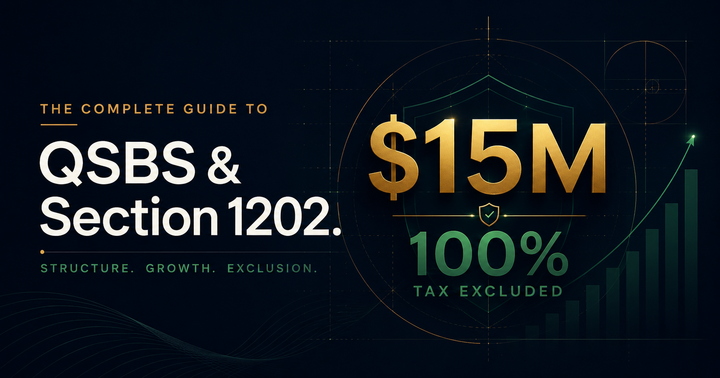
Everything founders, investors, and advisors need to know about Qualified Small Business Stock — from qualification requirements to exit planning. Updated for the 2025 One Big Beautiful Bill Act.
Qualified small business stock (QSBS) is stock in a domestic C corporation, acquired at original issuance, that lets a shareholder exclude capital gain from federal tax under Section 1202. For stock issued on or before July 4, 2025, the exclusion is 100% after a 5-year hold, capped at the greater of $10 million or 10× basis per issuer. For stock issued after that date, the OBBBA raised the cap to the greater of $15 million or 10× basis and added tiered exclusions — 50%, 75%, and 100% after 3, 4, and 5 years — with the issuer gross-asset ceiling raised from $50 million to $75 million.
If you sell a business in or after 2028, this one rule can change your tax bill by seven figures.
Washington's new 9.9% income tax under ESSB 6346 makes QSBS more valuable than ever:
- Qualifying QSBS gains can be excluded from federal tax
- Because Washington's new income tax starts from federal AGI, excluded QSBS gains generally never enter the WA tax base
- Non-QSBS gains for a high earner can face roughly 20% + 3.8% + 9.9% ≈ 33.7% combined (federal LTCG + NIIT + WA, after the capital-gains-tax credit against the income tax)
That gap is material.
In This Guide
- What Is QSBS?
- What Changed Under the Big Beautiful Bill (2025)
- Qualification Requirements
- Who Benefits — Founders, Investors & Employees
- Entity Structure: Why Only C-Corps Qualify
- The Holding Period & Tiered Exclusion
- The Exclusion Cap: $10M vs. $15M
- Section 1045 Rollovers
- QSBS and Trusts & Estates
- State-by-State Conformity
- Common Pitfalls That Blow the Exclusion
- Attestation Letters & Documentation
What Is QSBS?
Qualified Small Business Stock (QSBS) refers to shares issued by a U.S. C corporation that meet the requirements of Section 1202 of the Internal Revenue Code. If you hold QSBS for long enough and sell it, you can exclude a substantial amount of capital gain — potentially all of it — from federal income tax.
This is, by a wide margin, the most significant tax benefit available to startup founders and early-stage investors. On a successful exit, the difference between qualifying for the Section 1202 exclusion and not qualifying can be measured in millions of dollars.
- $15M — Max excludable gain per issuer (post-OBBBA)
- 100% — Exclusion after 5-year hold
- $75M — Gross asset threshold (post-OBBBA)
The basic idea is simple: Congress wants to encourage investment in small businesses, so it created a powerful incentive. If you acquire stock directly from a qualifying C corporation, hold it for at least five years, and the company meets certain requirements during that time, you pay zero federal income tax on the gain when you sell — up to a generous cap.
The details, as with most things in the tax code, are where it gets complicated. This guide walks through each requirement and the planning considerations that matter most in practice.
What Changed Under the Big Beautiful Bill (2025)
On July 4, 2025, President Trump signed the One Big Beautiful Bill Act (OBBBA), which made the most significant changes to Section 1202 in over a decade. These changes apply only to stock issued after July 4, 2025 — pre-existing QSBS is still governed by the old rules.
- Holding period for 100% exclusion: more than 5 years (pre-OBBBA) → at least 5 years (post-OBBBA)
- Partial exclusion: none — all or nothing (pre-OBBBA) → 50% at 3 years, 75% at 4 years (post-OBBBA)
- Per-issuer gain cap: $10 million (pre-OBBBA) → $15 million, inflation-adjusted from 2027 (post-OBBBA)
- Gross asset threshold: $50 million (pre-OBBBA) → $75 million, inflation-adjusted (post-OBBBA)
- Alternative cap: 10× adjusted basis — unchanged under OBBBA
Qualification Requirements
Not every share of stock qualifies for the Section 1202 exclusion. There are requirements at both the company level and the shareholder level, and all of them must be satisfied.
Company-Level Requirements
- Domestic C corporation — the issuing company must be a U.S. C corporation at the time of issuance, not an S corp, LLC, or partnership
- Gross asset test — aggregate gross assets cannot exceed $50 million (pre-OBBBA) or $75 million (post-OBBBA) at any time before or immediately after the stock issuance
- Active business requirement — at least 80% of assets must be used in the active conduct of a qualified trade or business during substantially all of the holding period
- Qualified trade or business — the business must not be in an excluded category (certain service industries, banking, insurance, farming, mining, hospitality)
Shareholder-Level Requirements
- Original issuance — the stock must be acquired directly from the corporation for money, property, or services; buying on the secondary market does not qualify
- Non-corporate taxpayer — available to individuals, trusts, estates, and pass-through entities; C corporations cannot claim the exclusion
- Holding period — for pre-OBBBA stock, more than five years for the 100% exclusion; for post-OBBBA stock, at least three years for 50%, four for 75%, five for 100%
Excluded Businesses
The following types of businesses cannot issue QSBS, regardless of size or structure:
- Professional services (health, law, engineering, architecture, accounting, actuarial science, consulting, financial services, brokerage, performing arts, athletics)
- Banking, insurance, financing, leasing, or investing
- Farming (including raising or harvesting timber)
- Mining, oil, gas, or other extractive industries
- Hotels, motels, and restaurants
Does a SaaS Company That Also Sells Consulting or Engineering Services Qualify?
The services exclusion is the most misread requirement in §1202, and it bites hardest for companies that sell software and bill for services alongside it — implementation, onboarding, customization, custom engineering, or advisory work. Whether that mix costs you QSBS turns on three separate questions. Founders routinely collapse them into one, and get the analysis wrong as a result.
- Is the company's trade or business an enumerated excluded field? §1202(e)(3)(A) lists specific service fields, two of which hit hybrids directly: consulting and engineering. If the business "involves the performance of services" in one of those fields, it is out. This is a character question about what the business does — not a percentage.
- Is the principal asset the reputation or skill of its employees? A separate catch-all in the same subsection. A company can avoid the named fields and still fail here if what it truly sells is its people's expertise.
- Is at least 80% of assets, by value, used in the qualified business? §1202(e)(1)(A). This one is mechanical and asset-based — not a revenue test. Assets devoted to a disqualified line do not count toward the 80%.
The tests are independent and measured differently. A company can pass one and fail another.
The good news for product companies: the IRS has issued a run of private letter rulings reading the reputation-or-skill catch-all narrowly for software and IP businesses. In PLR 202319013 (2023), it held that an enterprise cloud-software company's principal asset was its own intellectual property — not its employees' skill — even though those employees had specialized technical skills, because the skills were proprietary to the company and could be taught to new hires. Earlier rulings reached the same result for software used by healthcare providers (PLR 202144026), a pharmaceutical company (PLR 201436001), and a laboratory-testing business whose services were performed by highly trained staff (PLR 201717010). The Tax Court took the same narrow view in Owen v. Commissioner, T.C. Memo. 2012-21, holding that the principal asset of a company selling prepaid legal-service plans was its training and organizational structure, not any one person's skill. There is also a structural reason the catch-all is read narrowly: a broad reading would swallow the specifically enumerated fields — health, law, engineering, and the rest — and make them redundant.
Where the line actually gets drawn for a hybrid: the most useful ruling here is PLR 202342013, involving a data-migration and management business. That company sold no software at all — it was a pure services shop — and the IRS still held it was not engaged in "consulting," which puts a software company with an embedded services component on at least as strong a footing. The ruling turned on two facts the IRS treated as pivotal: the advice the company's employees provided was ancillary to and in support of the implementation work it actually delivered, and the company did not separately bill for that advice — it billed only for the finished, implemented solution. The practical lesson: how you package and invoice implementation and professional-services revenue is not cosmetic. A services line that is broken out, scoped, and billed separately as advisory, consulting, or custom-engineering work resembles the excluded field far more than the same work bundled into and priced as part of the product.
Custom engineering carries extra risk. "Engineering" is one of the named fields, so a SaaS company that sells custom development or engineering work as a distinct, separately-billed line starts closer to the exclusion than one selling generic "advice." The ancillary-and-bundled framing still helps, but the enumerated status raises the stakes and the documentation burden.
Clearing the character question is not the finish line. Even a company that is squarely a qualified trade or business must keep at least 80% of its assets, by value, in that business across substantially all of the holding period. None of these rulings is binding: under §6110(k)(3), a private letter ruling may be relied on only by the taxpayer who requested it, and no Treasury regulations interpret the reputation-or-skill or consulting language at all. The IRS has since stopped issuing private rulings on the active-business question, placing it on its no-rule list in Rev. Proc. 2024-3 while it studies regulations. This is a facts-and-circumstances area with real money riding on getting the characterization — and the documentation — right before an exit, not after.
Who Benefits — Founders, Investors & Employees
The Section 1202 exclusion is a per-taxpayer, per-issuer benefit. That means each person who holds qualifying stock in a given company gets their own exclusion. This is powerful because it means founders, angel investors, seed-round participants, and early employees who receive stock can each independently exclude up to $10 million (pre-OBBBA) or $15 million (post-OBBBA) of gain from the same company.
Founders
If you form a C corporation and acquire your founder shares at par value, you have the maximum potential exclusion available — your basis is near zero, so nearly all of your exit proceeds are gain, and the exclusion shelters up to $15 million of it (or 10× your basis, whichever is greater). For most founders paying a fraction of a penny per share, the flat cap will be the binding constraint.
Angel Investors
Angels who write checks directly to the company in exchange for stock at original issuance qualify. The 10× basis alternative can be especially valuable here: an investor who puts in $2 million gets at least a $20 million exclusion, which can exceed the flat $15 million cap.
Employees & Contractors
Stock received for services — including through the exercise of stock options — can qualify as QSBS. The key is that the employee acquires the stock directly from the corporation. For options, the QSBS clock generally starts when the option is exercised, not when it's granted.
Entity Structure: Why Only C-Corps Qualify
This is the single most important structural decision for QSBS purposes, and it's also the one that's most frequently gotten wrong. Only stock issued by a C corporation can be QSBS. Not an LLC. Not an S corporation. Not a partnership.
If you form as an S corp, your founder shares will never qualify — even if you later revoke the S election, stock issued while the election was in effect is permanently disqualified. If you form as an LLC, your membership interests don't qualify, but you can convert to a C corporation and start the clock from the date of conversion.
Conversions in the other direction — from a regular Delaware C-corp to a Delaware Public Benefit Corporation — do not affect QSBS. A PBC is still a C corporation for federal tax purposes, and a §242 charter amendment does not terminate corporate existence, restart the holding period, or change the gross assets analysis.
The Holding Period & Tiered Exclusion
Under the pre-OBBBA rules (stock issued on or before July 4, 2025), the holding period is binary: hold for more than five years and get the 100% exclusion, or don't and get nothing (unless you do a Section 1045 rollover).
The OBBBA introduced a tiered structure for stock issued after July 4, 2025:
- 3 to less than 4 years held → 50% gain exclusion; remaining 50% taxed at 28% (§1202 gain) + 3.8% NIIT
- 4 to less than 5 years held → 75% gain exclusion; remaining 25% taxed at 28% (§1202 gain) + 3.8% NIIT
- At least 5 years held → 100% gain exclusion; $0 federal tax
The Exclusion Cap: $10M vs. $15M
The Section 1202 exclusion is not unlimited. There are two caps, and you get the benefit of whichever is larger:
- The flat cap: $10 million per issuer for pre-OBBBA stock, or $15 million per issuer for post-OBBBA stock (with inflation adjustments starting in 2027)
- The basis multiplier: 10 times the taxpayer's adjusted basis in the stock — this is where investors with larger check sizes can significantly exceed the flat cap
These caps are per issuer and per taxpayer. A married couple where each spouse independently acquired QSBS may each have their own exclusion — but this is an aggressive position. The §1202(b)(3) joint-filing interaction is unsettled: the statute doesn't directly address whether joint filers get one cap or two, the IRS has not issued guidance, and no reported case has endorsed two-cap treatment. The position also depends on each spouse holding the stock as separate property, which is far easier to establish in common-law states than in community-property states like Washington, California, Texas, or Idaho — community-property characterization can collapse the position to a single shared cap. Some practitioners treat the two-exclusion reading as supported by reasonable basis (a recognized, but relatively weak, penalty defense standard), and commonly pair it with trust-based stacking as the more reliable backup. Similarly, gifting QSBS to family members or using trusts can multiply the number of available exclusions — but the rules here are technical and require careful planning.
Trust-based stacking is a service we offer — attorney-led structuring with trust drafting by estate planning counsel at my firm. See QSBS Trust Stacking Planning.
Section 1045 Rollovers
What happens if you need to sell your QSBS before the five-year mark? Section 1045 provides an escape valve: if you've held the stock for more than six months, you can defer the gain by reinvesting the proceeds into new QSBS within 60 days.
Unlike Section 1202, the 1045 rollover has no dollar cap on the amount of gain that can be deferred. And the holding period of the original stock tacks onto the replacement stock, so you can still reach the five-year mark for a full 1202 exclusion on the replacement shares.
Key Requirements
The original stock must be QSBS that you've held for more than six months. The replacement stock must be newly issued QSBS — you can't buy it on a secondary market. The reinvestment must happen within 60 days of the sale. And the replacement corporation must meet the active business test for at least six months after issuance.
QSBS and Trusts & Estates
Trust and estate planning can multiply the number of available exclusions within a family — or destroy QSBS status entirely if handled carelessly. This is one of the most powerful and most technical areas of Section 1202 planning.
Grantor Trusts
A grantor trust is disregarded for income tax purposes — the grantor is treated as the owner of the trust's assets. This means QSBS held by a grantor trust is treated as held by the grantor, and the grantor claims the exclusion. Transferring QSBS to a grantor trust is generally safe and does not restart the holding period or trigger a disqualifying event.
Non-Grantor Trusts
This is where it gets complicated. A non-grantor trust is a separate taxpayer, which means it gets its own Section 1202 exclusion — but the trust must have acquired the stock at original issuance (or through a qualifying transfer) to claim it. Transferring QSBS to a non-grantor trust can be a powerful exclusion-multiplication strategy, but the transfer must be structured correctly to avoid losing the benefit.
Gifting QSBS
Gifting QSBS to family members or trusts can create additional exclusions, but the rules are nuanced. The recipient generally inherits the donor's holding period and basis, and must independently meet the requirements. Gifts to non-grantor trusts for the benefit of multiple beneficiaries can potentially multiply exclusions, but this area requires careful coordination between startup counsel and estate planning attorneys.
Estates and Inherited QSBS
QSBS that passes through an estate at death can retain its QSBS character. The heir inherits the decedent's holding period under §1202(h)(2). Whether the §1014 date-of-death stepped-up basis applies for purposes of the 10x basis multiplier in §1202(b)(1)(B) is unsettled — practitioners disagree, and there is no controlling IRS guidance. Estate planning around QSBS often involves deciding whether to gift shares during life (to multiply exclusions) or hold them until death (to get a stepped-up basis for non-1202 purposes).
State-by-State Conformity
The Section 1202 exclusion is a federal benefit. Whether your state respects it is a separate question — and the answer varies significantly.
Most states conform to Section 1202, meaning if your gain is excluded federally, it's also excluded at the state level. But several important states do not:
- California — does not conform; potential state tax on $15M excluded gain: ~$2M (13.3%)
- Pennsylvania — does not conform; ~$460K (3.07%)
- New Jersey — conforms from 2026; $0 (non-conforming before 2026)
- Oregon — does not conform from 2026; ~$1.49M (9.9%)
- Alabama, Mississippi — do not conform; varies
- Washington — conforms for now; $0, but legislation pending
- Texas, Florida, Wyoming, Nevada — no state income tax; $0
Common Pitfalls That Blow the Exclusion
The Section 1202 exclusion is generous but fragile. Most disqualifying mistakes are avoidable with proper planning.
Wrong Entity at Formation
Forming as an S corp or LLC when a C corp was the right choice. S corp shares are permanently disqualified. LLC interests don't qualify, though you can convert and start the clock from that date.
Exceeding the Gross Asset Threshold
If the company's gross assets exceed $50 million (pre-OBBBA) or $75 million (post-OBBBA) at any time before or immediately after issuance, the stock doesn't qualify. Large fundraising rounds can push a company over this limit.
Redemptions and Repurchases
Section 1202 contains anti-abuse rules around stock redemptions. Significant redemptions within certain windows around the stock's issuance date can disqualify the stock — even if the redemption involves different shareholders.
Trying to "Reset" or "Refresh" QSBS
Exchanging old QSBS for newly issued shares to get the OBBBA's better terms does not work. Unless the exchange falls into a narrow statutory exception (like a tax-free reorganization under Section 368), you'll lose QSBS status entirely.
Failing the Active Business Test
The company must use at least 80% of its assets in an active qualified business during substantially all of the holding period. Companies that accumulate too much cash or investment assets relative to operating assets can fail this test.
Poor Record-Keeping
There is no QSBS "certificate." Qualification is determined by facts and circumstances, and the burden of proof is on the taxpayer. If you can't document that every requirement was met at the relevant times, you may not be able to claim the exclusion even if the stock technically qualified.
This is exactly how the taxpayer lost in Ju v. United States No. 22-1815T (Fed. Cl. Mar. 18, 2024) — the first federal court decision on a litigated §1202 claim. He could not produce evidence that the gross assets test was met at issuance (after-the-fact financials were rejected), and his claim to have owned the shares before their formal issuance failed because no records showed the parties treating him as the owner. The court did not hold that the stock failed to qualify — it held that he failed to prove it did. For §1202 purposes, those are the same outcome.
Attestation Letters & Documentation
There is no formal IRS process for certifying that stock is QSBS. Unlike an 83(b) election, there's no form to file at the time of issuance. QSBS status is determined based on whether the requirements were met — and the taxpayer bears the burden of proof.
This makes documentation critical. Best practice is for the issuing company to provide shareholders with a QSBS attestation letter at the time of issuance confirming that, based on the company's knowledge, the stock meets the Section 1202 requirements. The letter should cover the company's gross assets, its C corporation status, the nature of its business, and the terms of the issuance.
These letters aren't legally required, but they matter when filing a return claiming the exclusion, during an IRS audit, and in due diligence. Companies that skip them are doing their shareholders a disservice.
Need Help With QSBS Planning?
Whether you're forming a company, planning a financing, or approaching a liquidity event, getting QSBS right can save millions. Book a free consultation to discuss your situation.
A note before you book: please share only the names of the parties and a brief, non-confidential description of your issue. Confidential details should wait until we've completed a conflicts check and signed a written engagement agreement.
Related Reading
- Washington's New Income Tax: What Founders, Investors, and High Earners Need to Know
- QSBS Eligibility Checklist (Section 1202)
- The Big Beautiful Bill: A New Era for QSBS and Startup Investment
- Only C-Corps Can Issue QSBS — and That's a $15 Million Reason to Care
- Leveraging IRC Section 1045: Rolling Over QSBS Gains Before the Five-Year Mark
- Can Both Spouses Claim the QSBS Exclusion?
- 2026 QSBS State-by-State Conformity Guide
- QSBS Attestation Letters: Required or Just Smart Planning?
Disclaimer: This guide is provided for informational purposes only and does not constitute legal or tax advice. Section 1202 is complex and fact-specific — always consult with a qualified attorney or tax advisor regarding your particular situation. Joe Wallin is a corporate and tax attorney at Carney Badley Spellman, P.S. in Seattle, Washington.
© 2026 The Startup Law Blog. All rights reserved.
Want the Full 289-Page Technical Treatment?
Real-world examples, issue-spotting checklists, and planning strategies for every stage — from formation to exit.
Need Help With Your QSBS Situation?
QSBS Issue-Spotting Review — a fixed-fee engagement to identify Section 1202 qualification issues before a sale, financing, restructuring, or major planning decision. Designed for founders, investors, and startup employees.
Related Resources
- Washington State Taxes for Startups — how state tax proposals affect QSBS planning
- The Complete Guide to Equity Compensation — stock options, restricted stock, and QSBS intersection
- Startup Law Tools — QSBS calculator, WA tax calculator, entity selector
- Services — full list of how Joe helps founders and investors
Washington's New Millionaires' Tax and QSBS: Washington passed a 9.9% income tax on household income above $1 million (ESSB 6346) on March 30, 2026. The good news for QSBS holders: gains excluded under Section 1202 are excluded from federal AGI and therefore should not be subject to the new tax.
Washington founders should also review the Washington State capital gains tax and how it interacts with the Section 1202 exclusion at exit.
Need help verifying your QSBS status? See our Section 1202 QSBS Confirmation Services for hands-on review of your qualifying stock.