
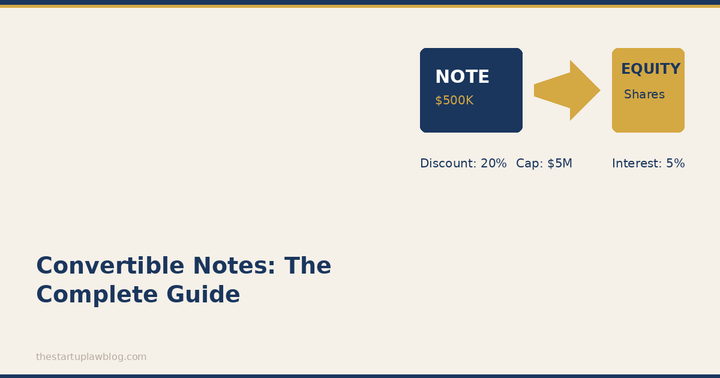
A convertible note is debt a startup issues now that is designed to convert into equity later—usually preferred stock in a priced financing—rather than remain outstanding as long-term debt. The company receives cash; the investor receives a promissory note with principal, interest, a maturity date, and conversion terms. Those terms commonly include a valuation cap, a discount, or both, which set the conversion price when a qualifying financing closes. Until conversion or repayment, the holder generally has creditor rights under the note. Convertible notes sit alongside SAFEs and priced equity rounds as a financing option; the right instrument depends on conversion economics, repayment and maturity obligations, investor requirements, and the expected financing timeline.
In This Guide
- → What Is a Convertible Note?
- → Key Convertible Note Terms
- → How Convertible Note Conversion Works
- → Valuation Cap vs. Discount
- → What Happens at Convertible Note Maturity?
- → Convertible Notes vs. SAFEs
- → Convertible Notes as Debt: Security and Subordination
- → Interest Accrual and Conversion Shares
- → Qualified Financing Thresholds and Conversion Triggers
- → Most Favored Nation Clauses
- → Amendment and Waiver Provisions: Why These Matter
- → Securities Law Considerations: Regulation D and Accredited Investors
- → Tax Implications: OID, Interest Deductions, and Debt-Equity Characterization
- → QSBS Timing When a Convertible Note Is Treated as Debt
- → Common Mistakes: How Founders Get This Wrong
- → Practical Advice for Negotiating Convertible Note Terms
- → Preparing a Priced Round After Convertible Notes
- → Reviewing Convertible Note Terms
Before issuing notes, model the conversion shares and identify what happens if the expected financing does not occur. The provisions below affect both investor rights and the company’s future financing options.
What Is a Convertible Note?
A convertible note is debt that can convert into equity under agreed terms. In startup financing, the note specifies interest, repayment obligations, and conversion rights.
A financing that meets the note’s qualified-financing definition can trigger automatic conversion at the contractual price. Read that definition together with the maturity and sale-event terms.
A priced preferred-stock financing usually requires more documentation and negotiation over governance and investor rights than a convertible-note financing. Selling preferred stock to investors does not inherently require a Section 409A valuation. Section 409A valuation rules are relevant to compensation arrangements, including setting stock-option exercise prices. A financing can provide new valuation evidence for subsequent option grants. See 409A Valuations: What Every Startup Needs to Know. Treas. Reg. §1.409A-1(b)(5).
Key Convertible Note Terms
Principal is the amount owed before interest. A $100,000 advance ordinarily creates $100,000 of principal, subject to the agreement. The note specifies repayment and conversion rights; neither guarantees recovery if the company fails.
Interest. Check the rate, accrual period, day-count convention, compounding, and whether interest is paid in cash or converted. Do not assume accrued interest receives the same conversion price as principal.
Maturity date is the contractual payment or decision point. Check whether payment, a demand, or a conversion election is required, or whether conversion is automatic. Calendar the deadlines and required approvals.
Valuation cap sets a ceiling used to calculate the conversion price. The note (and often the charter’s defined capitalization)—not a generic “pre-money fully diluted” convention—controls the denominator: which outstanding shares, options, reserved option-pool shares, SAFEs, and other converting instruments count. Confirm whether the cap is pre-money or post-money. A lower conversion price gives the investor more shares for the same amount.
Discount. A 20% conversion discount generally means the investor pays 80% of the new investors’ price per share. Apply the contractual price formula rather than multiplying an unspecified pre-money or post-money valuation.
How Convertible Note Conversion Works
Assume a $500,000 note with 5% annual simple interest, a $15 million pre-money valuation cap and a 20% discount converts after one year. The new investors contribute $5 million at $2.00 per share. For this simplified example, assume both pricing formulas use 17,500,000 pre-financing fully diluted shares, excluding the converting note, with no option-pool increase or other converting instruments. That produces a $35 million pricing base; because the note is excluded from that base, adding only the new cash does not describe the fully diluted post-financing valuation.
Assume this closing satisfies the note’s qualified-financing definition and triggers automatic conversion. The calculation is:
First, calculate the principal plus accrued interest. You have $500,000 principal. At 5% annual interest, after one year you've accrued $25,000, bringing your total to $525,000.
Second, compare conversion prices. The discounted price is $2.00 × 80% = $1.60. The cap price is $15,000,000 ÷ 17,500,000 = approximately $0.857142857. Assuming the agreement uses the lower price and applies it to both principal and interest, the cap controls.
Third, divide the converting amount by the note’s conversion price. Using the unrounded cap price, $525,000 ÷ ($15,000,000 ÷ 17,500,000) = 612,500 shares. The new investors receive 2,500,000 shares for their $5 million. The total becomes 20,612,500 fully diluted shares under these assumptions. Different capitalization definitions, option-pool changes or treatment of accrued interest can change the result.
Valuation Cap vs. Discount
A valuation cap does not insure the investment or preserve a fixed ownership percentage through later financings. Whether it controls the conversion price depends on the cap, discount, and capitalization definitions.
A discount can control even when the financing valuation is below the cap. For example, assume a $12 million pricing base and a $15 million cap both use 10 million fully diluted shares. The new-investor price is $1.20; a 20% discount produces $0.96, while the cap produces $1.50. If the agreement uses the lower price, $0.96 controls. Multiplying that price by the same 10 million shares gives a $9.6 million pricing equivalent, not a change to the company’s negotiated financing valuation.
When a note has both a cap and a discount, the usual structure uses whichever produces the lower conversion price, and therefore more shares for the investor. It does not use the greater valuation. Calculate each price under the agreement’s definitions; the two formulas may use different capitalization denominators. Example of a filed note agreement.
Caps and discounts are negotiated together with interest, maturity, and other rights. The figures in this guide are illustrations, not current market benchmarks. Compare proposed terms with relevant, dated financing data before describing them as typical.
What Happens at Convertible Note Maturity?
A note may reach maturity before a qualified financing closes. Plan for that outcome even if the company expects to raise another round.
Reaching the stated maturity date does not answer every payment or default question. Determine whether payment is then due, whether a demand or conversion election is required, and whether an extension or waiver applies. If a required payment is not made, assess default and remedies under the note’s notice, cure, and enforcement provisions.
Possible negotiated outcomes include an extension, conversion at an agreed price, or revised payment terms. Each requires the applicable approvals. Do not assume holders will agree or that negotiations suspend an existing payment obligation.
Choose a maturity date alongside the company’s cash forecast and the note’s actual repayment and conversion provisions. If the expected financing closes after maturity, plan how the intervening obligation will be handled. Five notes reaching maturity together do not necessarily require five separate negotiations: a valid collective-amendment provision may permit a coordinated extension, while separately negotiated notes or protected terms may require individual consents. Illustrative collective-amendment provision, §5(e)
Maintain one schedule of all notes showing maturity dates, notice and election deadlines, outstanding balances, and required approvals. Common maturity dates can simplify administration, but can also concentrate repayment exposure. Different dates can spread payment demands while increasing administrative work. Evaluate the cash requirements and contractual rights under both schedules.
Convertible Notes vs. SAFEs
A SAFE (Simple Agreement for Future Equity) offers a different set of financing rights. For the decision framework, see the SAFE vs. convertible note guide.
A standard YC SAFE is not a loan and has no interest or maturity date. It nevertheless provides contractual rights to cash or other proceeds in specified liquidity and dissolution events. Those rights are subject to the SAFE’s payment priorities and available proceeds. The absence of a loan-repayment obligation does not mean the company can never owe a SAFE holder cash. YC SAFE User Guide.
Without interest or a maturity date, a standard SAFE avoids note-extension and accrued-interest issues. Pro rata participation rights can be documented separately. Financial-statement classification is a separate accounting question; do not assume that every SAFE must be reported as equity merely because it is not a loan.
Compare payment rights as well as conversion economics. A standard YC SAFE’s cash-out rights in a sale or dissolution rank behind outstanding debt, including unconverted notes. A noteholder may recover money if assets remain available for its claim, subject to liens, subordination, and applicable insolvency priorities. The possibility of a total loss does not make SAFE and note protections equivalent. YC SAFE User Guide, liquidity and dissolution priorities Chapter 7 distribution priorities
A note may fit when the parties want interest, creditor rights, and a negotiated maturity outcome. A standard SAFE avoids interest and maturity extensions, but may remain outstanding indefinitely if no terminating event occurs. A longer expected wait for a priced round makes the note’s maturity terms more consequential; it does not by itself favor debt. Choose based on the actual rights, financing timeline, and dilution model rather than treating round size or investor sophistication as decisive. YC SAFE User Guide
Convertible Notes as Debt: Security and Subordination
Until conversion, the investor generally holds creditor rights. Payment timing, conversion, security, and subordination depend on the documents.
An unsecured convertible note gives the investor a contractual payment claim but no lien on company assets. A secured note requires an enforceable security interest and the appropriate perfection steps for the collateral. Filing a UCC-1 can perfect many security interests, but the filing alone does not create the lien or establish priority over every competing claim. For example, under Washington’s Article 9, a security interest in a deposit account as original collateral generally requires control for perfection. Recovery depends on the collateral, competing liens, applicable priority rules, and the insolvency process. Washington attachment requirements Washington collateral-specific perfection rules
A Series A preferred-stock financing is an equity investment. The investors do not become lenders merely by buying preferred shares. The note’s qualified-financing provision determines whether the note converts at that closing; the financing documents should address any notes that remain outstanding. Debt subordination is a separate issue: a bank or other lender may require noteholders to subordinate their payment or lien rights under an intercreditor or subordination agreement. A preferred-stock liquidation preference governs rights among equity holders and does not itself put those investors ahead of creditors. NVCA equity-financing model documents
Keep financial-statement presentation separate from tax classification and contractual payment rights. Have the accountant apply the relevant reporting standards to the note’s terms, including its conversion and settlement features. Section 409A is a separate compensation-tax regime; it does not determine whether a financing instrument appears as debt or equity on the balance sheet. A financing may supply valuation evidence relevant to later option grants. See the 409A valuations guide. Treas. Reg. §1.409A-1
Interest Accrual and Conversion Shares
Include accrued interest in the conversion model. For example, assume 1,000,000 existing shares, a $200,000 note at 5% annual simple interest for exactly two years, and a $1 conversion price for both principal and interest. With no other issuances, principal alone produces 200,000 shares and 16.67% ownership for the noteholder. Including $20,000 interest produces 220,000 shares out of 1,220,000, or 18.03%. New financing shares, options, and other instruments would change these percentages.
A worked example with explicit timing: assume three notes bear annual simple interest, with no payments or compounding. A $200,000 note at 5% outstanding for 18 months accrues $15,000; a $150,000 note at 6% for 12 months accrues $9,000; and a $100,000 note at 5% for six months accrues $2,500. Using these exact year fractions, total interest is $26,500 and principal plus interest is $476,500. Actual dates and contractual day-count conventions can change the amounts. Calculate shares separately for each note using its conversion terms.
Accrual, payment, compounding, and conversion are different questions—and contractual interest accrual is not the same as the holder’s taxable income inclusion or the issuer’s interest deduction. Interest can accrue over time even if it is payable only at maturity or conversion. Monthly accrual does not itself mean monthly compounding. Simple interest is calculated on principal; compounding adds interest to the base on which later interest is calculated. Apply the note’s actual provisions for each step. Illustrative simple-interest and conversion provisions, §§2–3
Qualified Financing Thresholds and Conversion Triggers
A qualified-financing definition should specify the securities being sold, the minimum proceeds, and which closings and amounts count. For example, an agreement might require at least $500,000 of new cash from preferred-stock sales, excluding converted notes and SAFEs. Under that hypothetical definition, $400,000 of new cash plus $200,000 of converting notes does not meet the threshold. The filed note linked here illustrates an express exclusion for converting securities; its negotiated dollar threshold is different. Illustrative proceeds definition, §2(a)
A financing below the qualified-financing threshold may leave the note outstanding, but check for an optional conversion provision. Some notes let the holder or a specified holder majority elect conversion in a non-qualified financing. If no contractual conversion right applies, the parties may need an amendment or separate agreement to convert. Example of optional conversion, §3(b)
Read the qualified-financing definition together with the sale, change-of-control, and liquidation provisions. An acquisition or acquihire may trigger a separate repayment premium or conversion election even though it is not a qualified financing. A secondary sale ordinarily pays the selling shareholder rather than raising money for the company, but a control transfer can still trigger a separate provision. A strategic investment can qualify if it satisfies the note’s definition; the investor’s label alone does not decide the result. Example of separate liquidation-event rights, §3(c)
Choose the qualified-financing threshold with the expected round size and the consequences of conversion in mind. A lower threshold can trigger conversion sooner, but it can also end creditor rights in a smaller financing. Specify whether related closings aggregate, whether the threshold uses gross or net proceeds, and whether converted debt, SAFEs, or noncash consideration count. Model the definition against the planned financing; $500,000 is an illustration, not a generally appropriate threshold.
Most Favored Nation Clauses
A most favored nation (MFN) clause can give an investor rights when the company later issues securities on more favorable terms. Its scope and operation depend on the language the parties negotiated.
An MFN clause may provide an automatic adjustment, or it may require notice, an investor election, and an amendment. A later note with a $10 million cap does not necessarily reset an earlier $12 million cap merely because the earlier note contains an MFN clause. Check which issuances and terms are covered, any exclusions, and the election deadline. Some provisions require adopting the later instrument’s terms as a package rather than selecting only its lower cap. Example of a notice-and-election MFN provision, §1(d)
Before issuing a new note, review outstanding MFN provisions and side letters. Identify required notices, election periods, and amendments, and model the dilution if holders exercise their rights. Different caps or discounts do not automatically change every earlier note.
Amendment and Waiver Provisions: Why These Matter
For amendments and waivers, identify the required company and holder approvals, the notes included in a collective vote, how voting power is measured, and any terms requiring individual consent.
Identify whose consent the amendment clause actually requires. If all eight holders in a defined note series must approve an extension, one holdout can block it. If each note permits amendment by the company and that note’s holder, changing one note does not automatically require the other seven holders’ signatures. Review the purchase agreement, collective-voting provisions, protected terms, and MFN rights before determining the approval list. Example permitting company-and-holder or company-and-majority amendments, §5(e)
A negotiated collective-amendment provision can reduce holdout risk, but it must identify the required company and holder approvals and any protected terms. A majority threshold can bind dissenters only within the authority granted by the documents; it does not inherently protect minority holders. Consider individual-consent or equal-treatment protections for changes that affect holders differently. Illustrative company-and-majority amendment clause, §5(e)
Similarly, waiver provisions let the company ask investors to waive certain rights—for instance, waive the requirement that a certain financing be "qualified" so the note converts anyway. These should be negotiable, and you want to understand upfront what flexibility you'll have if circumstances require it.
Securities Law Considerations: Regulation D and Accredited Investors
Convertible notes are securities. Issuing them requires registration or an available exemption.
Rule 506(b) vs. 506(c). Rule 506(b) prohibits general solicitation and permits up to 35 counted non-accredited purchasers (subject to sophistication and disclosure conditions); accredited investors are excluded from that count under Rule 501(e). Rule 506(c) permits general solicitation, but all purchasers must be accredited and the issuer must take reasonable steps to verify that status. Both paths have other requirements, including bad-actor disqualification. Rule 506
Private note rounds commonly rely on Section 4(a)(2) and/or Regulation D. Form D is a Regulation D notice filing; it does not create the federal exemption. Even when Rule 506 preempts state registration, state notice filings, fees, and antifraud authority can remain. Before offering notes, choose an available exemption and document solicitation limits, purchaser qualifications, disclosures, filings, and resale restrictions with counsel.
Transfers. A convertible note is not freely transferable merely because it is a security. Assignment usually requires compliance with the note and purchase agreement (consent, notice, and legend requirements) and with securities-law resale limits. Plan any secondary sale, pledge, or estate transfer against both the contract and an available exemption.
Non-U.S. investors. Regulation D alone is not enough for an international raise. Where an offshore offering is intended, consider Regulation S; also address local securities and marketing rules, tax withholding on interest or other payments, and OFAC/KYC screening where applicable. Coordinate U.S. and foreign counsel before soliciting or closing.
Details: Regulation D Explained and 506(b) vs. 506(c).
Tax Implications: OID, Interest Deductions, and Debt-Equity Characterization
First, original issue discount (OID). OID generally equals the excess of the stated redemption price at maturity over the issue price. A note-and-warrant package can create OID because the purchase price is allocated between its components. Deferred interest is another important source: on a multiyear note, interest payable only at maturity generally is not qualified stated interest, which ordinarily must be unconditionally payable at least annually. Thus, paying face value for a note does not establish that it has no OID. Applicable OID rules can require the holder to include interest income before receiving cash. A conversion-price discount does not, by itself, mean the debt was issued below face value; analyze the full payment terms. A zero or below-market stated rate is not automatically prohibited, but Section 7872 can apply to specified below-market loan categories and requires its own analysis. Treas. Reg. §1.1273-1. OID inclusion rules.
Second, the company’s interest deduction requires its own analysis. Confirm debt treatment and the applicable timing rules, then consider limitations such as Section 163(j). Section 163(l) can disallow interest on certain corporate debt instruments payable in equity; its detailed conditions must be applied to the note. A holder’s interest or OID income does not guarantee the issuer a matching deduction. IRC §163.
Third, determine whether the instrument is debt or equity for federal tax purposes. The note’s label and book presentation do not settle that question. Analyze its terms and the relevant facts under applicable tax authorities. Section 385 identifies potentially relevant factors, including payment terms, subordination, debt-to-equity ratio, convertibility, and the relationship between stock ownership and ownership of the instrument; it is not a mechanical checklist that guarantees debt treatment. The tax conclusion affects whether the debt-specific rules discussed above apply. IRC §385
Conversion into stock is not automatically tax-free. Do not assume Section 351 or another nonrecognition provision applies to every note conversion. Analyze the conversion under the applicable authorities for that instrument and transaction. Separate principal from accrued but unpaid interest (and any OID): stock issued for accrued interest can have different income-inclusion and basis consequences than stock issued for principal. Get transaction-specific tax advice before treating conversion as a nonrecognition event.
QSBS Timing When a Convertible Note Is Treated as Debt
Section 1202 applies to qualifying stock. The discussion below assumes the note is treated as debt for federal tax purposes. If that classification is uncertain, resolve it before relying on a conversion date to determine QSBS eligibility.
A convertible note is not C-corporation stock and is not itself QSBS. For a note treated as debt for federal tax purposes, the ordinary §1202 stock holding period begins with the stock acquisition on conversion; time holding the note does not count toward the Section 1202 holding period. Stock issued on conversion may satisfy the original-issuance requirement if it is issued by the corporation in exchange for money or other property (a debt claim can be property), but that conclusion is not automatic merely because the investor earlier advanced cash for the note. Analyze the exchange, basis, and acquisition-date rules for the actual conversion. Do not assume stock issued for accrued interest has identical §1202 basis and acquisition consequences as stock issued for principal. Qualifying stock acquired after July 4, 2025 can receive a 50% exclusion after at least three years, 75% after four, and 100% after five. Stock in the earlier acquisition regime generally must be held for more than five years, with the exclusion percentage determined by its acquisition date. Apply the eligible-gain limit separately. IRC §1202(a), (b), and (i).
Apply the gross-assets test when the stock is issued on conversion. The test covers the corporation and any predecessor during the statutory period before issuance and the corporation immediately after issuance, including amounts received in the issuance. The base ceiling is $75 million for stock issued after July 4, 2025, indexed beginning in 2027; the earlier issuance regime uses $50 million. Aggregate gross assets generally means cash plus adjusted tax bases of other assets, with special rules for contributed property and controlled groups. A financing valuation is not the gross-assets figure. Analyze the conversion and related financing together. IRC §1202(d).
Earlier conversion can start the holding period sooner and permit issuance before the company exceeds the applicable gross-assets ceiling. It does not permanently secure QSBS eligibility. The company must satisfy the C-corporation and active-business requirements during substantially all of the stock holding period, and the original-issuance, redemption and other conditions still matter. The Complete Guide to QSBS and Section 1202.
Common Mistakes: How Founders Get This Wrong
Stacking notes without modeling dilution. Multiple notes with different caps, discounts, and interest create separate conversion outcomes. Model each note in the cap table before the next closing. Intentional differences across a note round are fine if the documents reflect them and outstanding MFN or amendment provisions are checked before the next closing—undocumented inconsistencies are the problem.
Evaluating an uncapped note by the missing cap alone. An uncapped note may still provide a discount, interest, repayment rights, and other protections. Model those terms before accepting or rejecting it.
Qualified-financing thresholds, maturity, MFN scope, and amendment authority are covered in the sections above—get those definitions right in the documents rather than rediscovering them at conversion.
Practical Advice for Negotiating Convertible Note Terms
Start with documents designed for a convertible note (term sheet, note purchase agreement, and promissory note)—not a SAFE form. Review any starting form for jurisdiction, financing terms, the securities-law exemption, and existing MFN or amendment obligations. YC SAFE documents are a different instrument.
Negotiate the cap with the dilution model in hand. When the cap controls, a higher cap favors founders and a lower cap favors investors, all else equal. Evaluate concessions alongside the discount, interest, maturity, and capitalization definitions.
If you accept an MFN or a collective-amendment provision, define its scope in the documents (covered issuances, election mechanics, voting threshold, and protected terms). The dedicated MFN and amendment sections above explain why those details matter.
Preparing a Priced Round After Convertible Notes
Before closing a priced round, reconcile every outstanding note against the actual financing terms. Confirm which notes convert automatically, which require elections or amendments, and how principal, interest, and conversion prices determine the shares issued. Confirm sufficient authorized shares for conversion; the note does not itself create or reserve shares. Notes create no issued equity before conversion, but they belong in the fully diluted conversion model from day one — “no shares yet” does not mean “no dilution.” Resolve any remaining debt and required consents in the closing documents. Where the financing uses a note purchase agreement plus individual notes, read both: representations, covenants, and collective amendment mechanics often live in the purchase agreement, while payment and conversion terms live in the note.
Frequently Asked Questions
What happens to a convertible note if the startup fails?
A noteholder’s recovery depends on available assets, any valid security interest, contractual subordination, and applicable insolvency priorities. Unsecured does not itself mean contractually subordinated. A creditor claim may recover little or nothing if assets are insufficient; expected conversion does not eliminate an outstanding note’s payment rights. Bankruptcy subordination rules
What is the difference between a valuation cap and a discount?
A valuation cap is an input to the contractual conversion-price formula; it does not cap the company’s actual financing valuation. A discount reduces the new investors’ price per share. If the note uses the lower of the cap and discount prices, compute both using the agreement’s definitions.
What is a typical convertible note discount rate?
The discount is negotiated; this guide uses 20% as an illustration, not a universal market benchmark. At a $1 new-investor share price, a 20% discount gives a conversion price of $0.80 if the discount controls. Compare the discount with the cap and the other terms rather than selecting a percentage in isolation.
Should I use a convertible note or a SAFE?
A standard YC SAFE has no interest or maturity date. A convertible note adds debt rights and negotiated interest, repayment, and conversion terms. Compare those rights, likely financing timing, and modeled dilution; raise size alone does not determine the better instrument. Convertible notes vs. SAFEs guide
Do convertible notes accrue interest, and how does it affect dilution?
Read the note’s interest and conversion provisions. If accrued interest converts, it can increase the shares issued; if interest is paid in cash, it does not itself create conversion shares. The rate, accrual period, simple or compound treatment, and conversion price determine the result.
What happens at a convertible note's maturity date?
Read the note’s maturity provisions. They may require repayment, a demand, or a conversion election, or provide for automatic conversion. An extension requires the specified approvals. Check deadlines and default provisions before assuming that cash is due or that the note has converted.
Reviewing Convertible Note Terms
I review convertible note terms for founders and investors—caps, discounts, maturity, MFN, amendment authority, and the conversion model—before the notes close. Cap table problems are easier to fix before closing than after—one reason to work with Joe before signing.
Book a 20-minute call to review your convertible note terms →